Printmaking has always lived in an interesting in-between space. It sits somewhere between intimacy and reproducibility, between the artist’s hand and the press, between fine art and public life.
Techniques like etching and lithography are often introduced in textbooks as historical processes, yet seeing them in person—within a living gallery context—reveals how alive and relevant they remain today.
That realization became especially clear during my recent visit to Chali-Rosso Gallery, where I spent time viewing their collections and speaking with a gallery associate about the works on display.
The experience offered not only a deeper understanding of printmaking techniques, but also insight into how galleries curate, contextualize, and preserve these works for contemporary collectors.
Etching: drawing with time and resistance
Etching is a printmaking process defined by line, patience, and chemistry. Traditionally created on a metal plate coated with an acid-resistant ground, the artist scratches through the surface to expose the metal beneath. When the plate is placed in acid, those exposed lines are bitten into the surface, creating grooves that later hold ink.
What makes etching so compelling is its expressive tension. The artist controls the drawing, but the acid introduces an element of chance. Lines can be deepened through repeated immersions, creating variations in tone and weight. The resulting prints often feel intimate and psychological—lines that breathe, hesitate, or intensify.
Historically, artists such as Rembrandt, Goya, and Dürer used etching not merely for reproduction, but for emotional exploration. Standing in front of etched works in a gallery setting, you begin to see how these marks carry time within them: the duration of the acid bath, the pressure of the press, the quiet repetition of editioning.
Lithography: where drawing meets chemistry
Lithography, by contrast, is built on an entirely different principle. Rather than carving or biting into a surface, lithography relies on the simple truth that oil and water repel each other. The artist draws directly onto a flat stone or plate using greasy materials—crayons, pencils, or liquid inks. Through chemical processing, the drawn areas attract ink, while the untouched surface repels it.
The result is a print that feels astonishingly close to drawing on paper. Pencil lines retain their softness, brush marks their spontaneity. This quality made lithography especially appealing to artists like Toulouse-Lautrec, Picasso, Chagall, and Daumier, who embraced its immediacy and expressive freedom.
Lithography also played a major role in shaping modern visual culture—posters, political cartoons, illustrated newspapers—bridging fine art and mass communication.
In a gallery context, however, lithographs reclaim their intimacy. You notice the grain of the stone, the subtle shifts in pressure, the hand behind the mark.
Encountering the works at Chali-Rosso Gallery
Walking through Chali-Rosso Gallery, the diversity of media immediately stands out. Framed works on paper line the walls—drawings, prints, and editions—while sculptural pieces punctuate the space, creating rhythm and pause. The gallery’s presentation allows viewers to move fluidly between two and three dimensions, between line and volume.
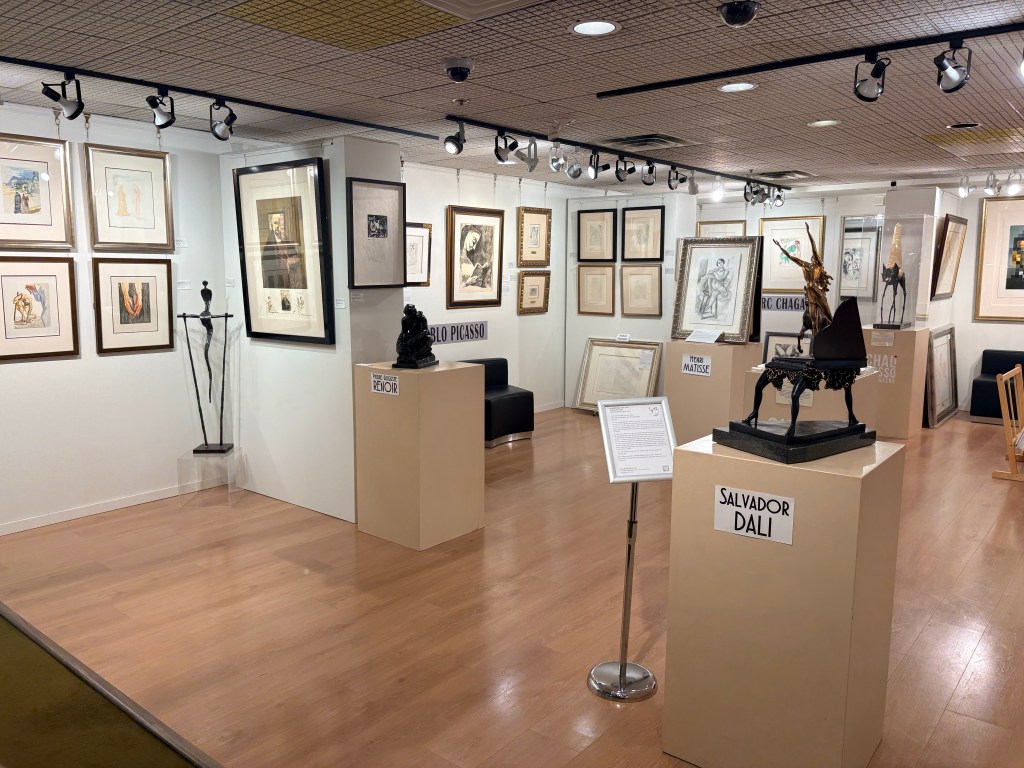
Several sculptures occupy the center of the gallery, each placed on a pedestal that invites slow viewing from all angles.
One particularly striking figure is a life-sized human form composed of small metallic discs, each catching light differently as you move around it.
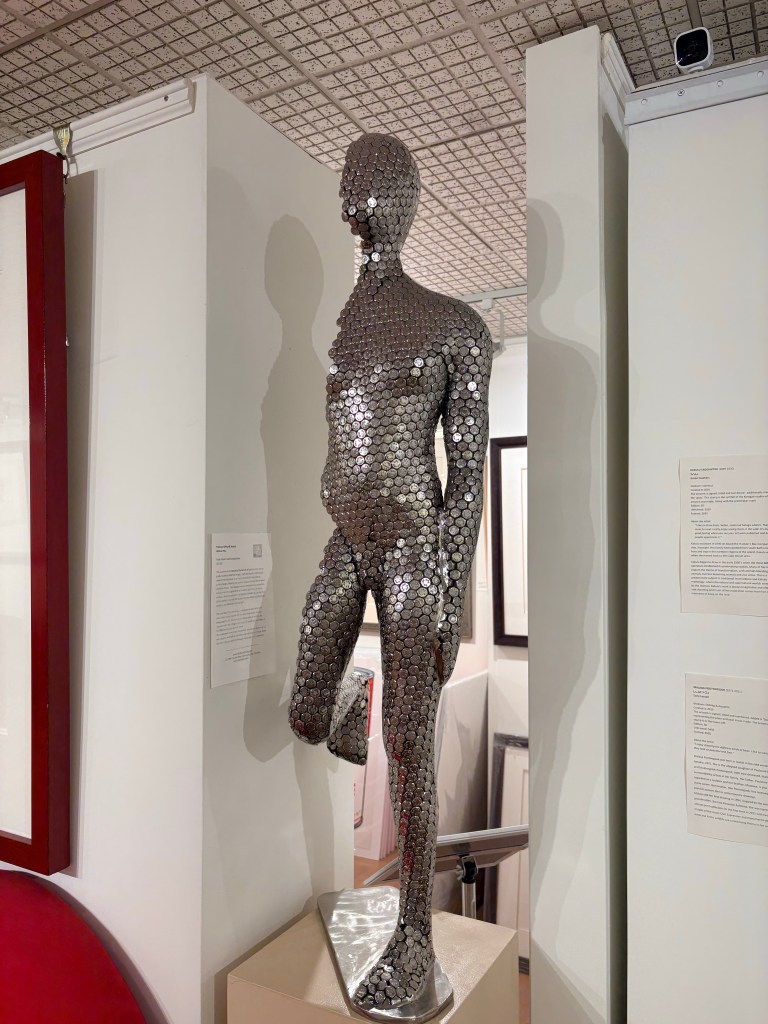
The surface feels both industrial and human, rigid and vulnerable at the same time. It’s a powerful contrast to the delicacy of works on paper nearby.
Elsewhere, sculptural works evoke movement, tension, and surreal imagery—forms that feel lifted from the imagination rather than anchored to realism. Seen alongside prints by modern masters, these sculptures reinforce how different mediums speak to one another within a curated space.
During my conversation with the gallery associate, I learned more about how Chali-Rosso approaches their collection: with attention to art historical significance, technical integrity, and collector education. The gallery does not simply display works; it contextualizes them—placing technique, artist, and era into quiet dialogue.
Why seeing prints in person still matters
Prints are often misunderstood as secondary or lesser than paintings or sculptures. Yet standing in front of an etched line or lithographic mark quickly dissolves that assumption. Prints reward close looking. They ask you to lean in, to notice pressure, texture, and intention.
In a time when images circulate endlessly online, the physical presence of prints becomes even more meaningful. The plate mark, the paper quality, the subtle inconsistencies between impressions—these are things no screen can replicate.
Chali-Rosso Gallery offers a space where these details are not only visible but respected. The visit reinforced a simple truth: printmaking is not just about technique; it is about translation—from hand to surface, from surface to paper, from past to present.
A quiet continuation
Leaving the gallery, I was reminded that techniques like etching and lithography are not frozen in history. They continue to evolve through new contexts, new collectors, and new conversations. Galleries like Chali-Rosso play an essential role in that continuation—bridging education, preservation, and lived experience.
To understand printmaking fully, you don’t just read about it. You stand in front of it. You let the lines, stones, and surfaces speak. And slowly, they do.
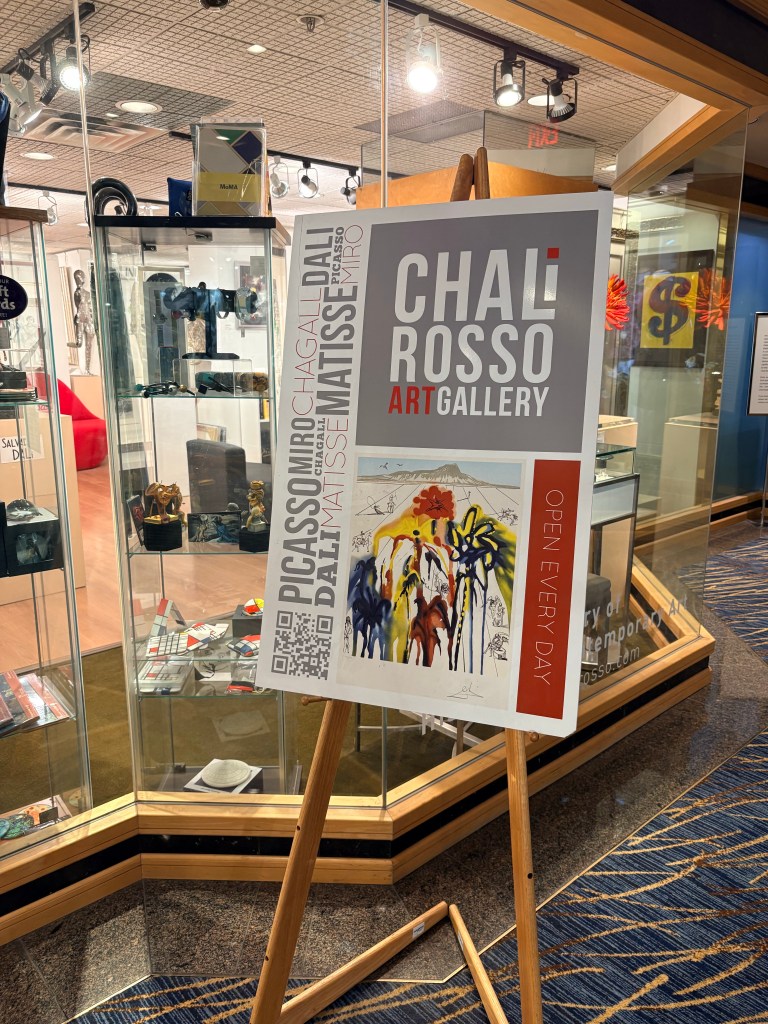
Chali‑Rosso Art Gallery
312–999 Canada Place, Vancouver, BC V6C 3G3, Canada
(604) 733-3594
Typically open Tuesday–Sunday, around 11 a.m.–5 p.m. (closed Mondays)
chalirosso.com – Gallery collection of Modern Masters and works on paper, with documentation and authenticity assurance.


 Reo's Gallery & Books [RGB]
Leave a comment